
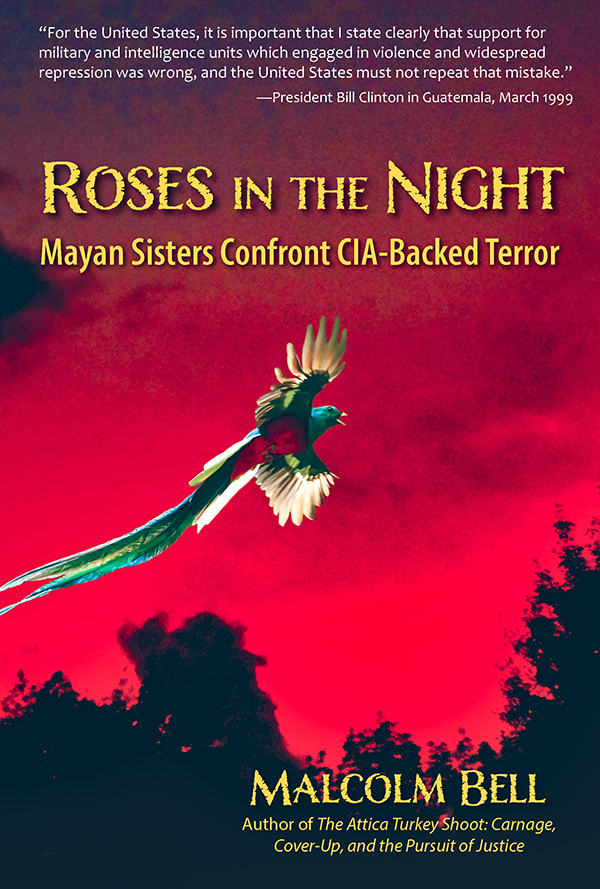
Roses in the Night
Malcolm Bell
ISBN 979-8-9889080-0-5 tradepaper
$19.99, 268 pages
ISBN 979-8-9889080-1-2 ebook
Available in bookstores everywhere and online at Bookshop.org
Hear Malcolm on WBAI radio about this story.
2025 Bronze Winner, Historical Fiction
CIPA EVVY™ Book Awards
This fact-based novel tells the story of two remarkable women. Maria, mindful that the CIA-advised army has wiped out hundreds of Mayan villages, struggles to save her own village from the soldiers’ rapes, bullets, and flames. Brenda tries to lead a normal life in Texas, Manhattan, and Vermont after being tortured by CIA-advised secret police. Both women strive to defeat their denial and make the hard choices needed to persevere. An Author’s Note at the end of the book relates the facts on which it is based.
“The character of Brenda, who is one of the Roses in the title of this fact-based novel, is modeled on a tri-lingual Mayan friend. Other friends survived torture by several U.S.-backed regimes in Latin America. I wrote the book for them, for the voiceless millions on the receiving end of ill-considered U.S. power, and for my beloved country, which can do better.”
—Malcolm Bell
Reviews
Bravo! I just finished your book, and I am so glad I read it. At times, it was hard to put down. I think you depicted torture thoroughly and accurately, as sad and tragic as it is. Your character development was excellent in that I felt I knew most of the characters well. I loved María’s courage, irreverence, and vigorous relationship with her family and community. You also effectively emphasized the centrality of spirituality in the culture. Also, using the Quetzal as the observer was brilliant—I even felt attached to the bird.
Brenda’s journey and torture story are quite detailed and an important aspect of the book. Her remarkable resilience shines through, as it does with so many survivors. Charlie was a great character and a testament to sensitive men in the world. You did a great job with how denial can unfold and how post-traumatic stress symptoms can occur when the walls of denial start to fall.
Admittedly, I did not know the full history of Guatemala and El Salvador, and I am thankful for the knowledge I’ve gained through the book. Although I’ve worked with survivors of torture from over thirty other countries of origin who resettled in Vermont, your book gave me further insights into the horrific humanitarian crises of these countries.
— Karen M. Fondacaro, Ph.D. Professor Emerita,
Licensed Clinical Psychologist, Director, Connecting Cultures,
Director, New England Survivors of Torture and Trauma, University of Vermont
With searing detail, Malcolm Bell tells a story of brutality and terror, also of remarkable humanity, during Guatemala’s civil war (1960–1996). The U.S. helped engineer a 1954 military coup d’état that put in place a dictatorship that became one of the most brutal in Latin America’s history, one that lasted for more than four decades. These stories are part of that history. With keen insight into the human nature of both soldiers trained in brutal counterinsurgency tactics and their victims, and then his account of the U.S. Sanctuary Movement in which he participated, he bears witness to realities about which all Americans need to know. While this is a work of fiction, all the stories narrated here are of events that actually took place.
—Margaret Swedish, former director of the
Religious Task Force on Central America & Mexico
The 1980’s Sanctuary Movement in North America provided protection and accompaniment for refugees fleeing the death squads, torture, and massacre of hundreds of Maya villages in Guatemala. The refugees found a safe place in over 600 churches and synagogues to speak publicly about the U.S.-backed slaughter of the Mayan people. This relationship in Sanctuaries became transformative for North Americans.
Now, Roses in the Night invites the reader into the same journey through the stories of two Maya women trying to understand and survive the tragic violence as it swept over them. This fine novel will lead a reader into the culture and history of the Maya, providing the strength for these women to endure and survive. Their story will transform the reader just as the stories of the refugees transformed so many North Americans in the 1980’s.
—Rev. John Fife, Co-founder of Sanctuary Movement, Pastor Emeritus of Southside Presbyterian Church, Tucson
This is a story that we are happy to ignore but that is, I fear, more common than we like to admit. The first part has the power of an ancient folk tale, or Greek tragedy. The second part is fascinating on many levels. I am impressed by your compassion for the villagers and even for the soldiers. The characters all seemed absolutely real. I find it amazing that a Vermont Yankee could describe the life of a Guatemalan village and a refugee’s progress towards becoming a U.S. citizen with such empathy and accuracy.
—Richard Dougherty, longtime provider of food and education
to impoverished children in Cuernavaca, Mexico
From the quetzal’s first observations in its role as Greek Chorus to the final ponderings about torture and survival, Malcolm Bell has woven the Mayan theme of resistance during the years of civil war in Guatemala and El Salvador into the warp and weft of his historical novel, Roses in the Night. Unrelenting fear, terror and horror funded by their governments and the complicity of ours provide the weft, but the stronger warp threads of hope, perseverance, great courage and love predominate to create an unforgettable novel.
—Gail Mott, longtime human rights activist, former member of the Sanctuary
Movement, and co-publisher of Interconnect, a quarterly of the U.S.-Latin America solidarity community.
With compassion and candor, Malcolm Bell has captured a story that opens hearts and minds to better understand the depth of desperation that drives those who undertake enormous risks to enter a strange land, simply to find the same kind of safe and peaceful life that most of us take for granted.
—Christine Christopher, Emmy Award-winning film producer,
Sundance, Documentary Film Institute grantee
In Roses in the Night, Malcolm Bell has spun a tale of love and admiration for the courageous survivors and martyrs of Guatemala’s Mayan genocide. He deftly weaves together two worlds: a Mayan village in Western Guatemala in the 1980s and the beautiful, mountainous terrain of Vermont, home to Mayan refugees displaced by the violence. Full of revelations about US foreign policy toward Central America, the Sanctuary Movement, and the special needs of survivors of torture, this is a story that needs to be told and needs to be read by all who value the courageous opposition mounted to one of the United States’ most violent and devastating interventions. Most of all, this is a tale of love in its various modalities, including the latticework of solidarity between those oppressed and brutalized with the help of the US government and those who risk their own safety to walk with them and help them to heal. The stories in Roses in the Night are not easy to forget, and this is all the better; they need to be remembered.
— Patricia Davis, author, longtime human rights activist, Board President of the
Guatemala Human Rights Commission/USA, co-author of Sister Dianna Ortiz’s
memoir The Blindfold’s Eyes: My Journey from Torture to Truth.